Real Cause, Real Cure by Jacob Teitelbaum M.D
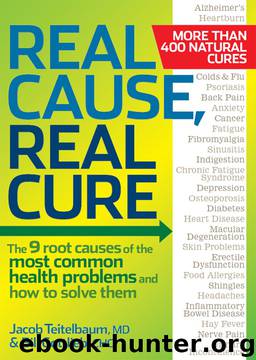
Author:Jacob Teitelbaum M.D.
Language: eng
Format: epub
Publisher: Potter/Ten Speed/Harmony/Rodale
Published: 2011-06-05T16:00:00+00:00
Breakthroughs in Nutritional Healing: Asthma
Several recent studies show the power of nutrition to tame asthma.
Vitamin C eases exercise-induced asthma. People with exercise-induced asthma who took 1,500 milligrams of vitamin C for 2 weeks dramatically reduced the number and severity of their symptoms, reported a team of researchers from the Human Performance and Exercise Biochemistry Laboratory at Indiana University, in the journal Respiratory Medicine. “Ascorbic acid [vitamin C] supplementation provides a protective effect against exercise-induced airway narrowing in asthmatic subjects,” they concluded.
More vitamin D, fewer trips to the emergency room. In a 4-year study of more than 1,000 children with mild to moderate asthma, researchers from Harvard Medical School found that those with the lowest blood levels of vitamin D were 50 percent more likely to go to the emergency room or be hospitalized with an asthma attack.
In a study of 100 asthmatic children, those with the lowest blood levels of vitamin D had more allergies (which often worsen asthma) and a higher use of steroid medications (which control the disease but cause many side effects).
When researchers at the University of Colorado studied 54 adults with asthma, they found that those with the highest vitamin D levels had the strongest lungs and airways that were least likely to go into spasm, as well as the smallest production of stress hormones. “Supplementation of vitamin D levels in patients with asthma may improve multiple parameters of asthma severity,” concluded the researchers in the American Journal of Respiratory and Critical Care Medicine.
Magnesium eases asthma symptoms. Noting that earlier studies linked low blood levels of magnesium with asthma, researchers at Bastyr University in Washington studied 55 adults with mild to moderate asthma. Half received 370 milligrams a day of magnesium and half didn’t. After 6 months, those receiving the mineral had a 20 percent improvement in a measurement of breathing strength and fewer asthma symptoms. There was little change in the placebo group, according to the study, which was reported in the Journal of Asthma.
Download
This site does not store any files on its server. We only index and link to content provided by other sites. Please contact the content providers to delete copyright contents if any and email us, we'll remove relevant links or contents immediately.
Unwinding Anxiety by Judson Brewer(73414)
The Art of Coaching by Elena Aguilar(53639)
The Fast Metabolism Diet Cookbook by Haylie Pomroy(21252)
Rewire Your Anxious Brain by Catherine M. Pittman(18794)
Healthy Aging For Dummies by Brent Agin & Sharon Perkins RN(17121)
Talking to Strangers by Malcolm Gladwell(13533)
The Art of Thinking Clearly by Rolf Dobelli(10709)
Mindhunter: Inside the FBI's Elite Serial Crime Unit by John E. Douglas & Mark Olshaker(9511)
Crazy Rich Asians by Kevin Kwan(9412)
The Compound Effect by Darren Hardy(9144)
Tools of Titans by Timothy Ferriss(8588)
Periodization Training for Sports by Tudor Bompa(8414)
Becoming Supernatural by Dr. Joe Dispenza(8366)
Wonder by R. J. Palacio(8237)
Bodyweight Strength Training by Jay Cardiello(8027)
Crystal Healing for Women by Mariah K. Lyons(8002)
Change Your Questions, Change Your Life by Marilee Adams(7927)
Nudge - Improving Decisions about Health, Wealth, and Happiness by Thaler Sunstein(7848)
Therapeutic Modalities for Musculoskeletal Injuries, 4E by Craig R. Denegar & Ethan Saliba & Susan Saliba(7779)
